Dating in Japan: 87 Dates and the Art of Reading Silence
Eighty-seven dates across three visits to Tokyo, Osaka, and Kyoto. What tatemae, the last train at 23:30, and the silence of a six-stool Golden Gai bar taught me about reading what Japanese women never say out loud.
March 24, 2026
35.6762° N, 139.6503° E
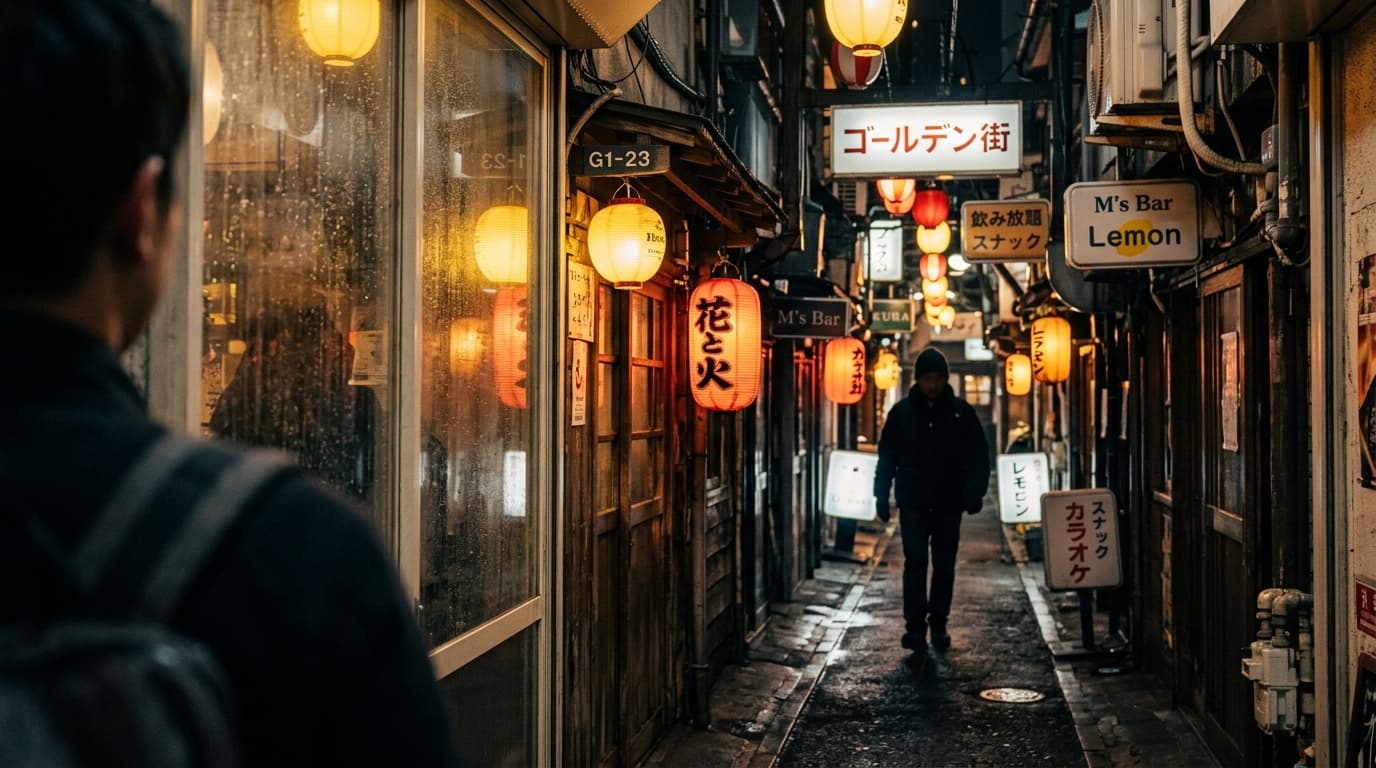
The bar had six stools. The bartender, Hana, poured Suntory Toki into a glass before I sat down. She'd been doing this since my first visit in March 2022, and by my third trip in early 2024 the ritual was wordless: I walked in, she poured, I sat on the third stool from the left, and we spent the next two hours in a silence that felt more like a conversation than most conversations I've had.
Golden Gai has over two hundred bars like this, stacked on top of each other in an alley system that would qualify as a fire hazard anywhere else on earth. Each bar holds six to ten people. You can hear the bar next door through the wall. The cover charge is 300 to 500 yen (about three dollars), and for that you get a seat, a drink, and the proximity to strangers that Japanese social architecture normally forbids.
I went back to Hana's bar eleven times across those three trips. She never asked my name.
Japan
What the Data Says
Eighty-seven dates. Seventeen weeks. Three visits: March to April 2022 (eight weeks in Tokyo, Osaka, and Kyoto; 38 dates), February to March 2023 (six weeks in Tokyo and Osaka; 27 dates), and January to February 2024 (three weeks in Tokyo and Kyoto; 22 dates).
Japan accounts for 5.8% of my 1,500 total dates. For context: Colombia gave me 141 dates across 29 weeks. Brazil gave me 112 in 24. Japan's 87 in 17 weeks is a respectable per-week average, until you factor in the effort. Each of those 87 required more patience, more calibration, and more silence than anything I'd encountered in Latin America or Eastern Europe.
The conversion numbers tell the real story. Cold approach to actual date: roughly 2 to 3 percent. App match to first meeting: around 15 percent. First date to second: about 60 percent, which sounds high until you realize the filtering happened before you ever sat down across from her. She decided she was interested when she agreed to meet. The date is a formality. She already decided.
Second date to physical intimacy: 30 to 40 percent, usually by the third or fourth meeting. In Colombia my average was 1.8 dates to the same milestone. Japan tripled it.
Seventeen of those 87 came from izakaya counters. I didn't approach anyone. I sat down, ordered a highball, said oishii about the tsukune, and let proximity do the rest. My notes from that period, scribbled on my phone at 1am: "Nakameguro counter. Did literally nothing. She commented on the chicken. Talked for two hours. She paid for my last drink. WHAT IS THIS COUNTRY."
The Five Invisible Walls
Every country has unwritten rules. Japan has five, and they govern every interaction you will ever have with a Japanese woman. The mistake most foreigners make is treating these as curiosities. They are load-bearing walls.
Wa (harmony). The group matters more than the individual. A Japanese woman will sit through twenty minutes of a conversation she wants to escape rather than create a single moment of public friction. She will smile while doing it. She will nod. If you interpret her composure as enthusiasm, you will keep talking, and she will keep suffering, and both of you will leave the interaction with completely different stories about what happened. Your job is to notice the suffering.
Tatemae and Honne. Tatemae is the public mask: polished, agreeable, warm. Honne is the real feeling underneath. Western culture has a version of this, but in Japan it operates at an entirely different scale. A woman's tatemae can be so convincing that seasoned expats still misread it after years in the country. The rule is simple and painful: never trust words. Watch actions. Does she initiate contact? Does she suggest a second date? Does she remember what you said last time? Those are honne signals. Everything else is performance.
Kuuki wo yomu (read the air). The single most valued social skill in Japan: the ability to sense a room, to understand what people feel without them saying it. If you can't do this, you earn the label KY (kuuki yomenai), and in dating, KY is a death sentence. A KY man is the one who keeps talking when she's trying to leave. The one who escalates physically in a restaurant. The one who sends a fourth message after three non-responses. Japanese women won't tell you you're being KY. They'll just disappear.
Uchi/Soto (inside/outside). Japanese social life divides into uchi (the trusted inner circle) and soto (everyone else). Foreigners are soto by definition. The word gaijin literally means "outside person." A cold approach on the street asks a woman to let a soto person into her world in ninety seconds. This is why introductions through mutual friends, hobby groups, language exchanges, and shared social spaces convert at five to ten times the rate of street approaches. They bypass the soto wall.
Meiwaku (causing trouble). She won't reject you to your face because direct rejection creates meiwaku for both of you. Instead she'll say "chotto muzukashii" (it's a bit difficult) and wait for you to understand. If you ask again, she'll say "kangaete oku" (I'll think about it). Both mean no. If you ask a third time, she won't say anything. She'll just stop responding to your LINE messages, and you'll spend three days wondering what happened before the answer lands: you made her uncomfortable, and she handled it the only way her culture equipped her to handle it.
I learned each of these walls by walking into them. Sometimes the same wall twice.
My field notes from Tokyo, week two, written in all caps at 2am: "THEY DON'T SAY NO. THEY JUST STOP REPLYING. LEARNED THIS FOUR TIMES NOW. THE SILENCE IS THE ANSWER."
Survival Rules
JPThe Last Train Changes Everything
The last train in Tokyo departs between 23:30 and 00:30 depending on the line. After that, you either pay for a taxi (expensive) or stay out until the first train at 5:00 am. This sounds like a logistical footnote. It is the central mechanism of Japanese dating.
A woman on a third date who looks at the time around 23:15 and says "ah, shūden..." (the last train) with a trailing pause is asking you a question about something other than trains. She is giving you the most indirect signal Japanese culture allows for "I am open to this evening continuing." If you respond by telling her she should hurry so she doesn't miss it (which I did, in March 2022, with a woman named Yuki who had brought me homemade cookies from her home prefecture), you have failed the only test that mattered.
Yuki smiled at the station platform. A compressed smile, the kind you can only decode later, staring at a hotel ceiling in Ebisu, replaying the evening frame by frame.
I learned the last train lesson once. The entire love hotel industry exists because of this dynamic. Clusters of them sit within walking distance of major stations: Shibuya, Shinjuku, Ikebukuro, Ueno. The lobbies have touchscreens displaying available rooms so neither of you needs to speak to another person. The rooms have better amenities than most four-star hotels. Checkout is automated. The Japanese solved the logistics of private space the way they solve most things: with precision and zero unnecessary human contact.
A love hotel room runs 6,000 to 15,000 yen ($40 to $100) for a "rest" (two to three hours) or 8,000 to 20,000 yen ($55 to $130) for an overnight stay. In a country where adults commonly live with their parents well into their thirties, and apartments have walls thin enough to hear a neighbor's alarm clock, the love hotel is infrastructure.
The Dating Apps
More than half of my 87 dates came from apps. Japan's dating apps work nothing like any other country I've dated in, and getting it wrong wastes weeks.
Best Dating Apps
JP
The dominant serious dating app in Japan. Real profiles, ID verification, detailed bios. The women here are genuinely looking for relationships. Largest user base among Japanese-born women.
💡 Pro tip: Write your bio in Japanese, even imperfect Japanese. Use lifestyle photos: cooking, travel, a café. Abs photos get you filtered out instantly. Expect 3 to 5 dates before physical intimacy.
The dominant serious dating app in Japan. Real profiles, ID verification, detailed bios. The women here are genuinely looking for relationships. Largest user base among Japanese-born women.
💡 Pro tip: Write your bio in Japanese, even imperfect Japanese. Use lifestyle photos: cooking, travel, a café. Abs photos get you filtered out instantly. Expect 3 to 5 dates before physical intimacy.
Swipe-based, younger demographic (20 to 28). More casual than Pairs but still relationship-oriented by Western standards. The outing feature matches you based on shared date ideas.
💡 Pro tip: Use the outing feature: it lets you propose a date plan (coffee in Daikanyama, ramen in Ebisu) and match with women who want the same thing. Converts faster than standard swiping.
Swipe-based, younger demographic (20 to 28). More casual than Pairs but still relationship-oriented by Western standards. The outing feature matches you based on shared date ideas.
💡 Pro tip: Use the outing feature: it lets you propose a date plan (coffee in Daikanyama, ramen in Ebisu) and match with women who want the same thing. Converts faster than standard swiping.
Marriage-focused. Profiles include income range, family expectations, and life goals. Women here are screening for long-term compatibility, not a fun evening.
💡 Pro tip: Only worth using if you are genuinely open to a serious relationship. She will ask about your plans for Japan within the first three messages.
Marriage-focused. Profiles include income range, family expectations, and life goals. Women here are screening for long-term compatibility, not a fun evening.
💡 Pro tip: Only worth using if you are genuinely open to a serious relationship. She will ask about your plans for Japan within the first three messages.
In Japan, Tinder is the foreigner app. Most Japanese women on Tinder are specifically looking for foreign men. Matches come fast, flake rates are high, and the pool skews toward gaijin hunters.
💡 Pro tip: Good for volume and quick dates. Unreliable for finding women who are interested in you as a person rather than your passport.
In Japan, Tinder is the foreigner app. Most Japanese women on Tinder are specifically looking for foreign men. Matches come fast, flake rates are high, and the pool skews toward gaijin hunters.
💡 Pro tip: Good for volume and quick dates. Unreliable for finding women who are interested in you as a person rather than your passport.
Growing slowly but the user base is still tiny compared to Pairs or Tapple. The women-message-first mechanic makes many Japanese women uncomfortable.
💡 Pro tip: Run as a secondary app at most. The pool is too small to be a primary channel.
Growing slowly but the user base is still tiny compared to Pairs or Tapple. The women-message-first mechanic makes many Japanese women uncomfortable.
💡 Pro tip: Run as a secondary app at most. The pool is too small to be a primary channel.
LINE is everything. Install it before your plane lands. The only messaging platform that matters in Japan. WhatsApp does not exist here. iMessage does not exist here. Instagram DMs are for teenagers. Every date, every follow-up, every flirty exchange happens on LINE, with its stickers, its read receipts (called kidoku, and the source of immense anxiety on both sides), and its particular rhythm.
The LINE close on the street works like this: you open the app, tap "Add Friends," show your QR code, she scans it (or you scan hers), and you send an immediate callback message referencing the interaction. "The French guy from the Starbucks in Omotesando. You survived the conversation." Add a sticker. Something funny, never sexual. The sticker matters more than you think: it signals that you understand how LINE communication works in Japan, which signals that you are not fresh off the plane.
Response rate after a street LINE close: 40 to 60 percent for the first message, but only 15 to 25 percent will convert to an actual date. The rest gave you their LINE because saying no to your face would have created meiwaku.
Where the Dates Happen
Daygame (Adapted for Japan)
The word for cold approaching women on the street, nanpa, carries a stigma in Japan. It is associated with scammers, creeps, and the kind of men women warn each other about. The London Daygame Model (frontal stop, direct compliment, assertive vocal tone) causes genuine panic when deployed unchanged on a Tokyo sidewalk.
So what works is the walk-alongside. You match her pace, position yourself at a slight diagonal (never in front, never from behind), and open with something that gives her a reason to respond. "Sumimasen, kono hen de ii kafe wo shitte imasu ka?" (Excuse me, do you know a good café around here?). Sixty to ninety seconds. LINE exchange. Then she goes home, thinks about it alone in her apartment, and either responds that evening or vanishes. You won't know which until you know.
The best daygame spots, verified across my three trips:
Tokyo: Shibuya around the Scramble Crossing and Center-gai (massive foot traffic, 14:00 to 18:00, but heavy foreign competition). Omotesando and Harajuku (fashion-conscious women, better profiles, lower competition). Daikanyama and Nakameguro (sophisticated women 25 to 35, excellent for instant dates at the cafés). Shimokitazawa (indie and artsy types, very low foreigner density, Japanese language nearly required). Ikebukuro Sunshine City (underestimated, strong volume on weekends).
Osaka: Shinsaibashi and Namba (the Osaka woman is more direct, more expressive, and more willing to engage than her Tokyo counterpart; the conversion rate here ran noticeably higher for me). Umeda Grand Front (office women, lunch hours).
Kyoto: Kawaramachi along the Kamo River (students, cafés, relaxed pace). Kyoto is a city for dates. The tatemae runs deepest here; a Kyoto woman's yes can mean no, and her silence might mean everything.
Nightlife
Japanese nightlife follows a logic built around the last train. Before midnight: bars, izakayas, warm-up socializing. After midnight (the "magic hour"): everyone still out has committed to staying until 5:00 am, the guard drops, and interactions become radically easier.
The izakaya counter is the single most effective social environment in Japan for meeting women. The format forces proximity: you sit at a counter, order food and drinks, and conversation with the person next to you happens organically. By the third round of highballs, the tatemae is dissolving. Seventeen of my 87 dates came from izakaya counters where I approached no one. I just sat in the right place.
Golden Gai (Shinjuku): 200-plus micro-bars crammed into six narrow alleys. Each bar holds six to ten people. You physically cannot avoid talking to the person next to you. Some bars refuse foreigners (check before entering), but most welcome anyone who respects the space. Cover is 300 to 800 yen plus your drink. The crowd skews artsy, intellectual, and internationally curious. Golden Gai produced five of my dates across three visits.
Shibuya clubs: Womb (world-class techno, serious music crowd), Sound Museum Vision (large, multiple floors, good for moving between vibes), Club Camelot (mainstream, strong ratio of women to men). Entry runs 2,000 to 4,000 yen with a drink included.
Roppongi. Look. I went three times. A woman at Gas Panic told me within six minutes that she'd dated "many French guys." I asked how many. She counted on her fingers and ran out of fingers. I finished my drink and left. The dates in Roppongi were fast to get and forgettable to have. The women skew toward gaijin hunters, hostesses between shifts, and women whose interest in you expires the moment a newer foreigner walks through the door.
Karaoke deserves its own paragraph. Japanese karaoke is private rooms (not a stage), rented by the hour, with unlimited drinks (nomihodai) starting around 1,500 yen per hour. Inviting a woman to karaoke carries zero sexual connotation. It is a standard social activity. It is also a private room with alcohol and dimmed lighting. The transition from izakaya to nijikai (second round) to karaoke to love hotel is one of the most well-worn paths in Japanese dating, and everyone involved understands every step without it ever being stated aloud.
The escalation vocabulary, for the uninitiated: "Nijikai ikou!" (let's go to a second round). "Idou shiyou" (let's change places). "Kyukei shiyou" (let's rest). That last one is the universally understood euphemism for "let's go to a love hotel." Every Japanese adult knows this. Nobody acknowledges it.
Date Cost Index
1 = very cheap · 10 = very expensive
What Things Cost (The Real Numbers)
A coffee date: 500 to 1,000 yen ($3 to $7). An izakaya dinner for two with drinks: 4,000 to 6,000 yen ($27 to $40). A nice restaurant date: 8,000 to 15,000 yen ($55 to $100). Club entry with one drink: 2,000 to 4,000 yen ($14 to $27). A love hotel rest: 6,000 to 15,000 yen ($40 to $100). Monthly metro pass: about 10,000 yen ($65).
My monthly dating spend in Tokyo averaged $1,200 to $1,500. That includes dates, transportation, a few club entries, and two or three love hotel visits. It is expensive compared to Medellín ($400 to $600 a month for the same lifestyle) or Bangkok ($500 to $700). It is cheap compared to London or New York.
The hidden cost is time. The average Japanese dating timeline to physical intimacy runs three to five dates. In Colombia, my average was 1.8. Japan tripled it. Your real investment is measured in evenings and patience, and the exchange rate on patience is something no spreadsheet can capture.
The Four Archetypes
Patterns. Four of them. Every real woman I met existed somewhere between these categories or in defiance of them, but the patterns are there if you look.
Who You'll Meet in JP
Common personality archetypes encountered. These are patterns observed across many interactions, not exhaustive categories.
The OL (Office Lady)
25 to 32, works at a corporation, dresses immaculately, carries a brand-name bag even on weekends. She craves unpredictability but her entire life is structured to prevent it. Meet her at after-work izakayas in Ebisu or Marunouchi.
The Shimokitazawa Girl
23 to 29, works in something creative: a gallery, a vintage shop, a small music label. Her wardrobe looks like it was pulled from a 1990s Tokyo street style archive. She does not care about your nationality. She cares about your taste.
The Roppongi Regular
21 to 28, specifically seeks foreign men. English-capable, fast-moving by Japanese standards. Easy to meet at the HUB pubs and Roppongi clubs. The foreigner advantage at its most amplified and its most hollow.
The Kyoto Bijin
Any age, raised in Kansai. The tatemae runs deepest with her. Her agreement might be a refusal. Her silence might be desire. She speaks in a softer dialect. She represents the highest difficulty and the highest reward.
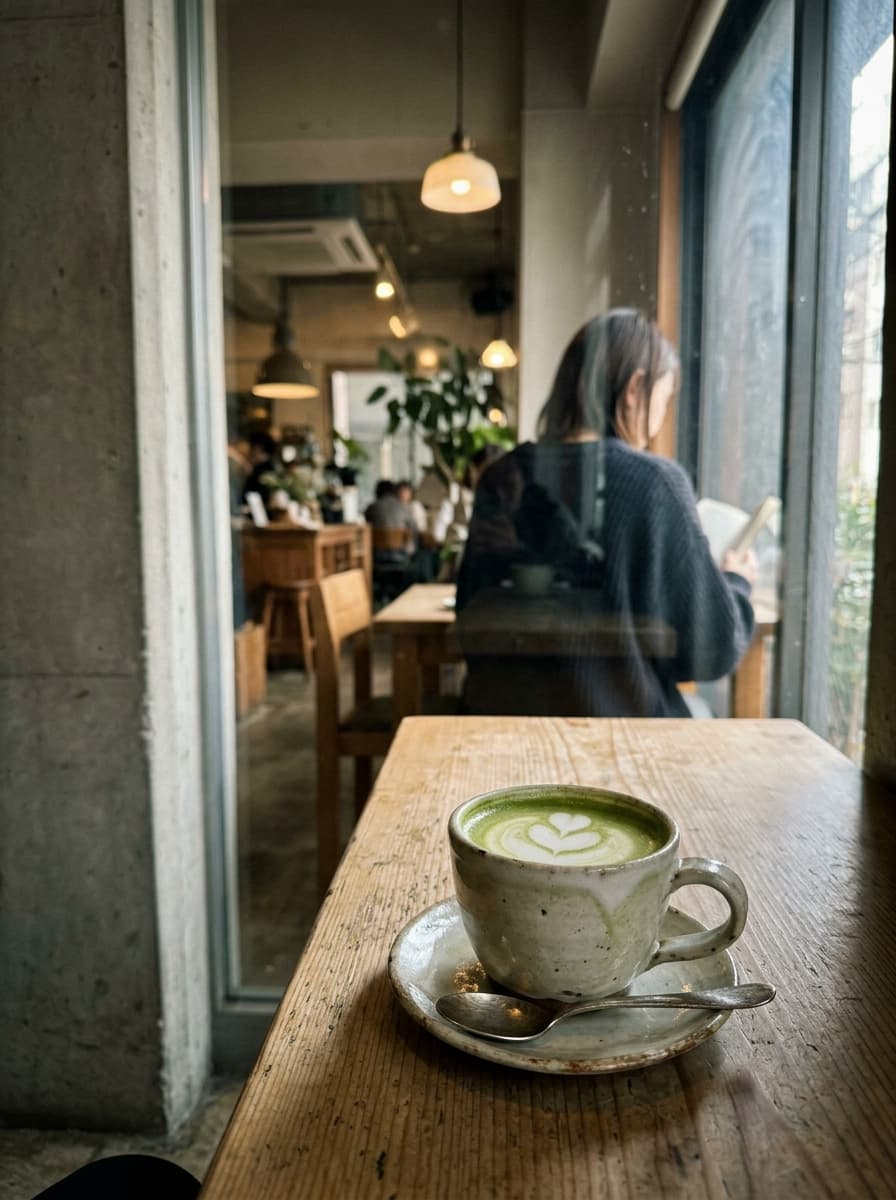
Yuki was the OL. I met her on Pairs. She arrived at our first date (a café in Daikanyama with exposed concrete walls and a single-origin pour-over menu) eleven minutes early and was visibly embarrassed about it. She had rehearsed three English sentences and delivered them all within the first ninety seconds. We switched to a combination of my broken Japanese and her broken English, and something in that mutual incompetence generated a warmth that fluency never could.
On our fourth date, at an izakaya in Ebisu Yokocho where the tables are close enough to share elbows with strangers, she told me she'd searched "how to talk to French men" before our first meeting. The results, she said, were confusing.
(I told her the results were probably accurate.)
Mika was the Osaka version: 26, worked at a design firm in Shinsaibashi, laughed louder than any woman I'd met in Tokyo, and told me on our second date that Osaka women think Tokyo women are "too quiet and too scared." She said this while eating takoyaki from a street vendor with sauce on her chin. She didn't wipe it off for two full minutes, and I found that more attractive than anything that happened in six weeks of Tokyo dating.
The Phrases That Open Doors
Japanese women respond to effort. Ten words of Japanese transforms you from "random foreigner" to "the one who tries." The bar is on the floor. Step over it.
Key Phrases
Japanese
Can You Read the Air?
Would you survive dating in JP?
Osaka vs Tokyo (A Necessary Aside)
I spent eleven of my seventeen weeks in Tokyo and four in Osaka. The remaining two went to Kyoto. Osaka deserves more than a footnote.
The Osaka woman is a different species from her Tokyo counterpart, and everyone in Japan knows it. Osakans are the southerners of Japan: louder, funnier, more direct, less wrapped in the tatemae that makes Tokyo interactions feel like correspondence chess. The standard greeting in Osaka is "moukarimakka?" (making money?), which would cause visible discomfort in a Tokyo elevator.
I noted this on my phone at 1am after a night in Shinsaibashi: "Tokyo women are chess. Osaka women are poker. Both are playing to win but one of them is having fun."
My approach-to-date conversion in Osaka ran roughly 40% higher than in Tokyo. Women engaged faster, laughed more openly, and dropped the mask earlier. The izakaya culture is even stronger (Osaka considers itself the food capital of Japan, and the city backs up the claim). Namba and Shinsaibashi at night have an energy that feels closer to Medellín than to Shibuya.
The trade-off: Osaka's dating pool is smaller, the foreigner novelty wears off faster in a smaller city, and the expat social infrastructure (language exchanges, international events) is thinner. For a two-week trip, I'd split it 60/40 in favor of Tokyo. For a month, I'd give Osaka equal time.
Fukuoka is the sleeper pick: Japan's highest ratio of young women to young men, the legendary Hakata bijin (beauties of Hakata), a tiny expat community (your foreigner status still means something), and the yatai (outdoor ramen stands along the river) where strangers sit at shared counters and conversation starts before the noodles arrive.
What I Got Wrong
Five mistakes, in order of how much they cost me.
One. Reading tatemae as attraction. A woman at a language exchange in Shimokitazawa laughed at everything I said, touched my arm twice, and gave me her LINE with a smile that could power a small city. I texted her the next day. She said she was busy. I suggested the following week. She said she'd check. I suggested a third time. She stopped responding. She had been polite. I had been KY.
Two. The last train with Yuki. Already documented. Still stings. I don't have a lesson for this one. I just have the memory of a half-smile on a train platform in March.
Three. Physical escalation in public. Second date with a woman from Pairs, ramen place in Ebisu. I put my hand on her knee under the table. She stiffened. She didn't say anything. The remaining forty minutes were two people performing normalcy while both knowing the evening was over. She texted "thank you for dinner" and never responded again. I spent the train ride home trying to figure out what I'd done wrong, which is funny, because I knew exactly what I'd done wrong. I just didn't want to admit that a gesture that would've been fine in Bogotá had ended a promising connection in Tokyo.
Four. Roppongi. Going there at all. Three nights, three easy connections, three women who were performing a version of interest calibrated for maximum foreigner engagement. By the third morning I realized the matches were fast because the women had done this dozens of times. I was a ticket.
Five. Underpreparing my Japanese. My first trip in 2022, I knew roughly fifteen words. The second trip, I knew fifty. The third trip, I had basic conversational ability (around N4 level). The difference in quality of interaction between trip one and trip three was so stark that I consider those early weeks partially wasted. Every phrase you learn in Japanese multiplies your access to women who would never match with you on Tinder, never go to a HUB pub, and never give their LINE to a stranger on the street. The real Japan lives behind a language wall, and climbing it even partway changes everything.
The Structural Truth
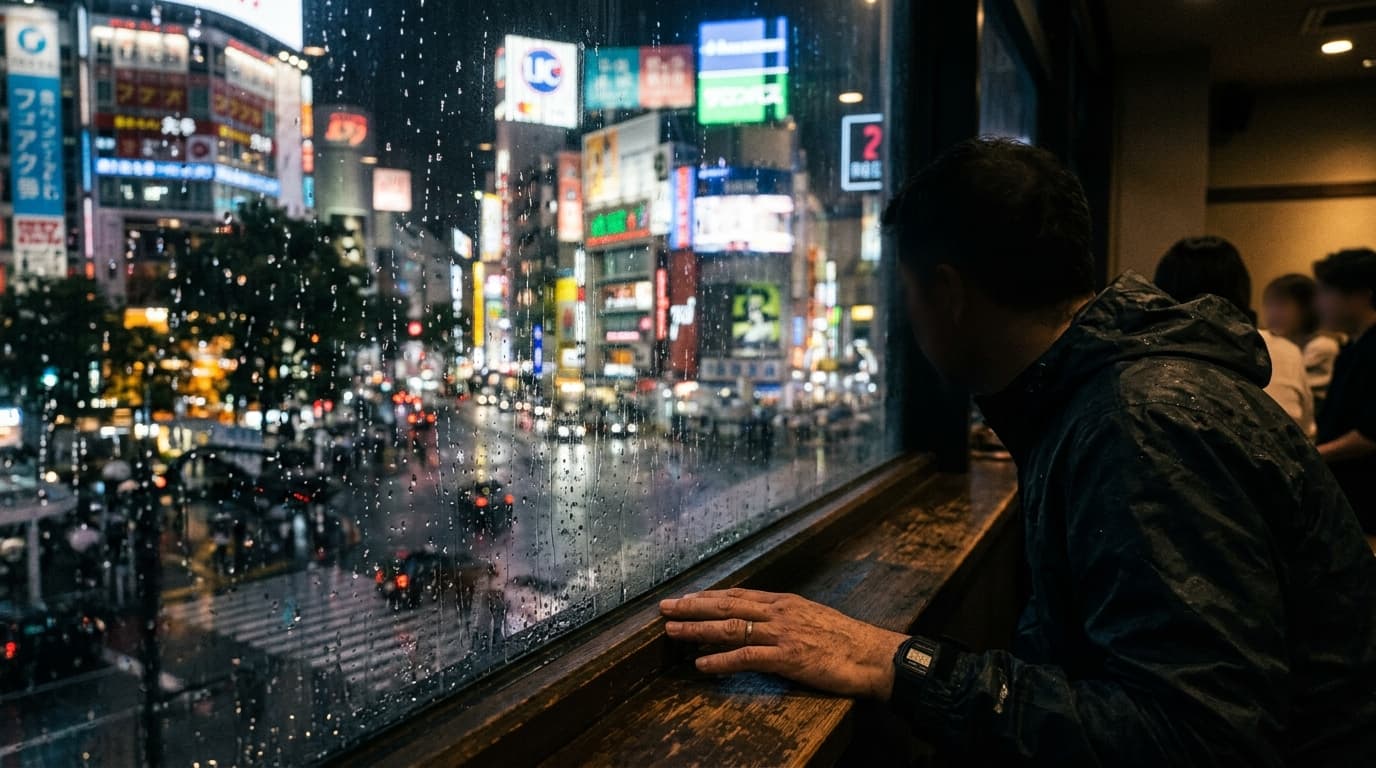
Shibuya crossing at 3pm on a Saturday. I stood there for ten minutes once, not approaching anyone, just watching. There is nowhere else on earth where that many immaculately dressed people move through the same intersection at the same time. I don't know why I'm mentioning this. It has nothing to do with dating. But I think about it more than most of the dates.
Anyway. Japan is the country that forced me to unlearn speed. Everywhere else, I had built everything around acceleration: faster reads, quicker escalation, shorter timelines. Latin America rewarded momentum. Eastern Europe rewarded persistence. Southeast Asia rewarded ease.
Japan rewarded stillness.
The best date I had in those seventeen weeks lasted four hours, and for the first forty-five minutes we sat in near-total silence at a ramen counter in Ebisu, eating. She slurped her noodles. I slurped mine. The cook worked. The radio played something by Tatsuro Yamashita. Occasionally she would point at a dish going to another table and raise her eyebrows. I would nod. She would nod. The cook would notice and bring us the same thing without being asked.
That silence carried something I didn't have a word for then, and still don't. Unless the Japanese concept of ma (the meaningful pause; the space between sounds that gives those sounds their shape) is the word.
I think it might be.

Back at the Bar
Hana's bar closed at 2:00 am. On my last night in Tokyo, February 2024, I stayed until she turned on the overhead lights (the ugly ones, the ones that make a bar look like what it actually is: a small room with bottles). She was wiping the counter. I was finishing my third Toki.
She said something in Japanese that I only partially understood. I asked her to repeat it. She said it again, slower. My brain assembled the words over the next few seconds: she was telling me that I had been coming to the same stool, ordering the same whisky, for three years, and that I was the only foreigner who had never tried to make conversation with her.
I told her I thought we'd been talking the whole time.
She covered her mouth when she laughed. In Japan, that means it was real.
More field notes. No spam. Unsubscribe anytime.
Related field notes
Dating in Poland: 37 Dates Between the Pew and the Pierogi
What 37 first dates across Warsaw and Krakow taught me about vodka, Sunday mass, the imieniny trap, and women who hold contradictions without apology.
52.2297,21.0122
Dating in Czech Republic: 44 Dates and the Bullshit Detector
What 44 first dates across Prague and Brno taught me about dark humor, the beer contract, the 50/50 exception, and a country that values sincerity above all else.
50.0755,14.4378
Dating in Ukraine: 45 Dates Before and After 2022
What 45 first dates across Kyiv and Odessa taught me about resilience, galanterie, curfews, and a country that rewrites the rules while keeping the heels.
50.4501,30.5234