Dating in Brazil: Warmth Is a System, Not a Feeling
The woman at the juice bar in Leblon touched my arm four times in ninety seconds. I counted. Forearm, shoulder, wrist, then the back of my hand when she la...
March 24, 2026
22.9068° S, 43.1729° W
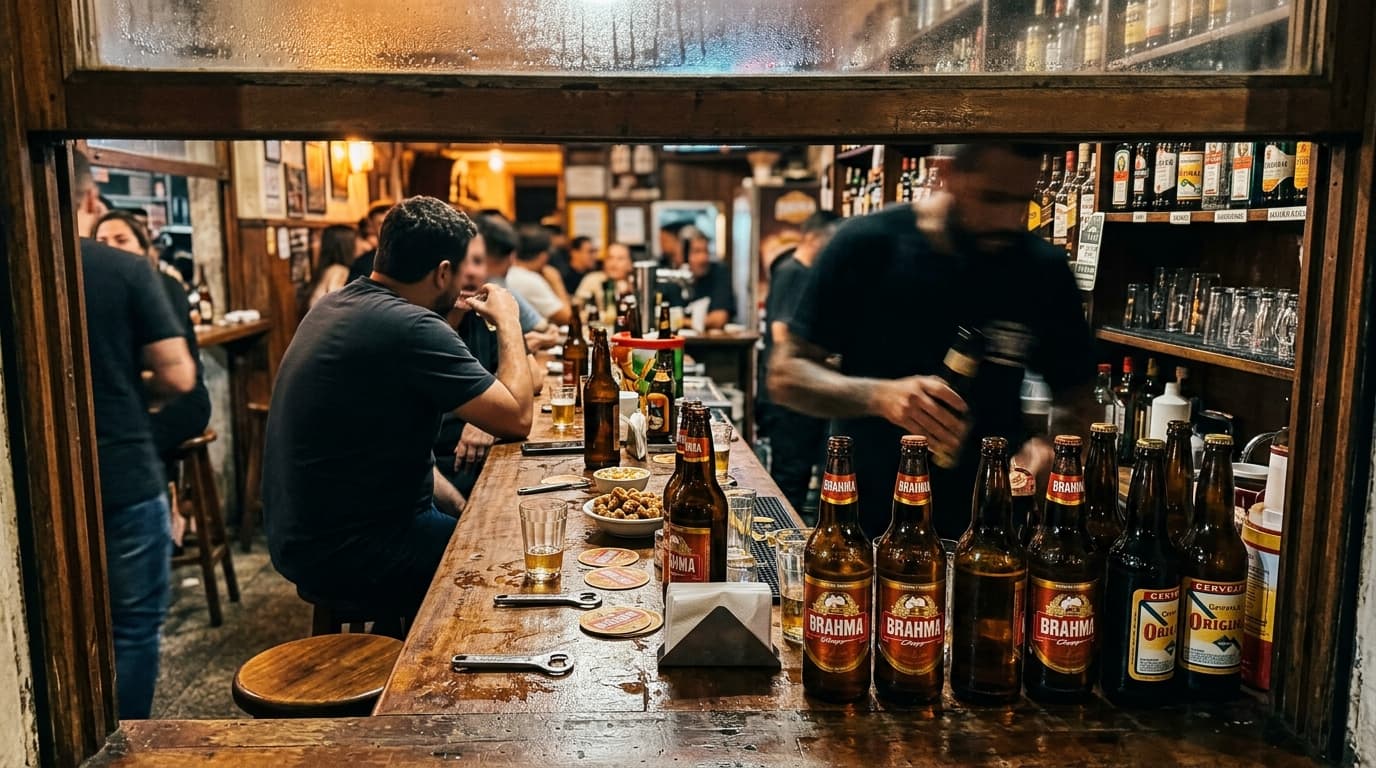
The woman at the juice bar in Leblon touched my arm four times in ninety seconds. I counted. Forearm, shoulder, wrist, then the back of my hand when she laughed at something I said about açaí that wasn't funny. I had been in Rio for six hours.
A man from Northern Europe would have proposed by dessert.
22.9068° S, 43.1729° W
Eleven weeks in Brazil across three trips: Rio de Janeiro, São Paulo, Florianópolis, Salvador, Belo Horizonte. Forty-seven first dates. Over two hundred cold approaches. Fourteen of those dates lasted past midnight. What I found wasn't what the internet promises. The warmth is real. The access it implies is manufactured by a social operating system most foreigners never bother to decode.
The Calibration Problem
Here is what happens to most men who land in Brazil. Within forty-eight hours, their entire framework for reading female interest collapses and rebuilds itself on bad data. A cashier smiles. A waitress holds eye contact for three full seconds. On a bus to Copacabana, a woman asks where you're from, touches your knee, gives you her Instagram without being asked. Every input reads as green light.
By day four, those same men sit in hostels staring at phones. Seven Instagram conversations gone static. Three confirmed dates that evaporated like rain on Copacabana asphalt. The woman who kissed them at Lapa on Saturday won't respond on Tuesday.
The failure is in the decoder.
Brazilian social architecture runs on a protocol I call thermal inflation. The baseline temperature of all human interaction is set so high that foreigners mistake room temperature for heat. A kiss on the cheek between strangers. Physical contact within the first thirty seconds of conversation. Verbal affection deployed with the casualness of a comma. These are the minimum viable social behaviors; the firmware of Brazilian communication, running on every unit regardless of intent.
(I learned this the expensive way. A woman named Juliana at a Botafogo padaria, the kind with fluorescent lights and plastic trays and a TV playing Globo at full volume above the register, smiled at me like I was the answer to a question she'd been carrying. I spent R$340 on a dinner she confirmed twice and never showed up to. The waiter brought me the check with a look I recognized from thirty countries: pity, cut with amusement. He cleared the second place setting without a word. That part stung more than the bill.)

What the Warmth Actually Is
Watch a Brazilian woman greet a friend she hasn't seen in two weeks. Now watch her greet a stranger at a party. The delta is roughly fifteen percent. Proximity, touch frequency, vocal warmth, eye contact duration: the architecture barely shifts. Trying to read romantic intent from Brazilian warmth is like trying to measure rainfall by staring at the ocean.
Three data points I documented across forty-seven first dates in five cities:
Average time before first physical contact: 2.3 minutes. Average number of touches per hour of conversation: 14. Average gap between "strong connection" and returned message the next day: 41% response rate.
That last number is the one that rewires you.
The warmth is sincere. Follow-through operates on entirely different circuitry. Two systems, sharing a body, running different code.
São Paulo Versus Rio: Two Operating Systems
São Paulo taught me something Rio's noise made impossible to hear.
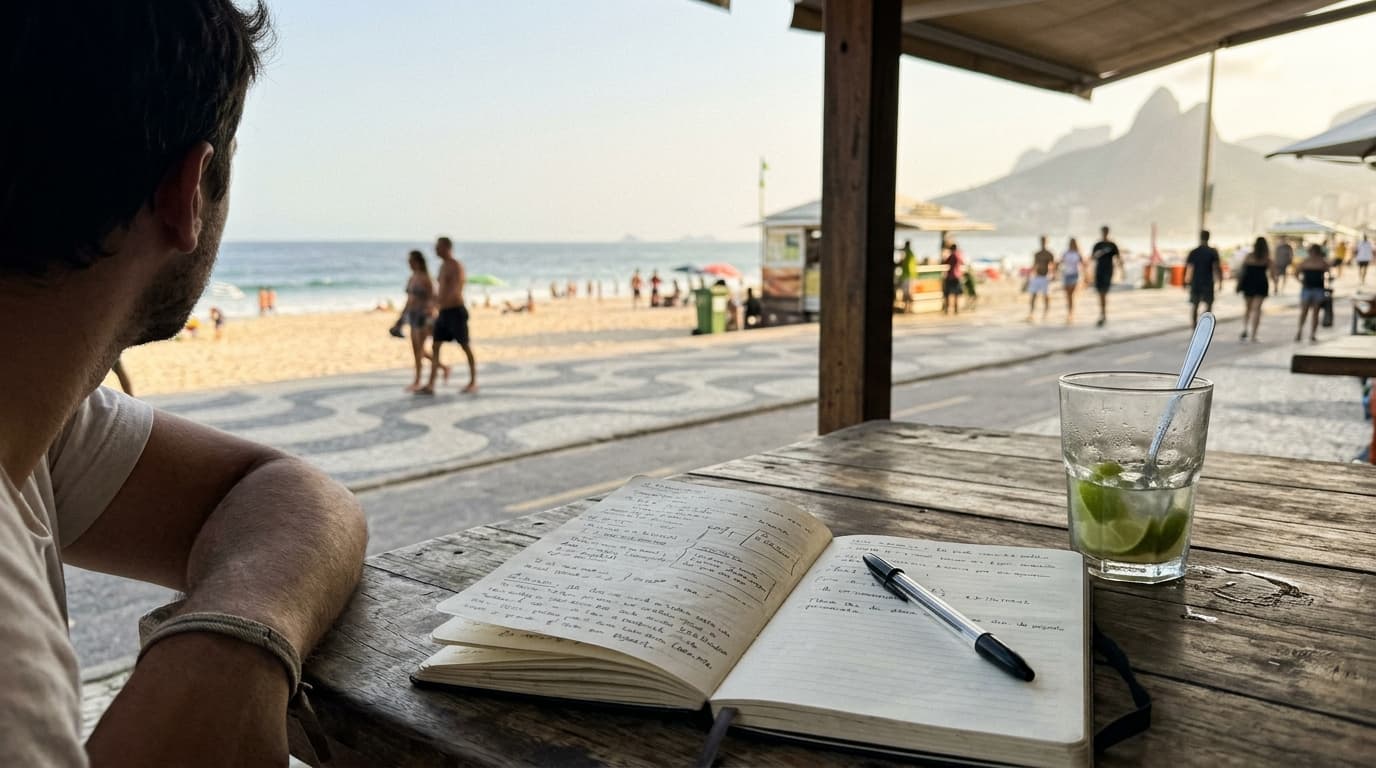
Rio runs its dating market like an open-air bazaar where everything appears available and nothing has a fixed price. Beauty is currency. Leisure is religion. A woman at a beach kiosk in Ipanema will talk to you for forty minutes, share her coxinha, laugh at your Portuguese, and vanish into the crowd without exchanging contacts. The interaction was complete in itself. It required no future. This drove me insane for three days until the circuit finally closed: the interaction was the point. A closed loop. The output was the process.
São Paulo is a corporate city wearing a carnival mask on weekends. Within the first four minutes (I timed it across twelve approaches on Rua Oscar Freire, standing near the Havaianas flagship where the doorman in a black polo watches the sidewalk like a bouncer sorting a queue), the question lands: what do you do. They are calibrating your position in a hierarchy they understand with the precision of a sorting algorithm.
Nine minutes. That's what a paulistana will give you before her filter returns a verdict. If those nine minutes pass, she will hand you her number and expect you to use it within twenty-four hours. The window is narrow because her time has a price she can articulate in reais.
Two cities. Same country. Completely different input-output logic. São Paulo selects harder, commits faster. Rio opens wider, commits to nothing. Both punish the man running the wrong protocol.
There was a café on Rua Augusta, near the corner with Consolação. I sat there three afternoons straight drinking espressos that cost R$9 and were worth R$3, watching the barista with a compass tattoo on her wrist that pointed south. Which seemed wrong. I started to form a theory about why someone would choose a compass that pointed south in a Southern Hemisphere city, but then the theory fell apart when I noticed it also pointed slightly east, and maybe it wasn't a compass at all. The same Marisa Monte album on rotation every time, Amor I Love You bleeding into the steam and the traffic noise from the buses braking at the light outside. I think about that café more than I think about several of the dates. Maybe São Paulo is a city that works on you laterally; you think you're collecting data, and it's collecting you.
Coming soonDating In Argentina...
Cultural Calibration Matrix
The Beijo Problem
A kiss in Brazil means nothing about what happens next. I need to say that first because everything below is damage control for men who already learned it wrong.
In forty-one of the fifty countries I've dated in, a kiss signifies escalation. A threshold crossed. Something permanent added to the ledger. In Brazil, a kiss at a party (the famous beijo) occupies approximately the same position on the commitment spectrum as accepting a drink in London. A social gesture with a half-life of six hours.
I watched a friend from Berlin kiss a woman at a forró night in Santa Teresa (the venue on Largo dos Guimarães with the blue door and the speaker wire taped to the ceiling with electrical tape) and spend the next four days engineering a future around her. She had kissed two other men that same evening. Not sequentially. The intervals overlapped. The beijo, in its Brazilian context, is a temperature check. Nothing more. His firmware couldn't process this. Mine barely could.
The men who suffer most here are those from cultures where physical escalation follows a strict linear sequence: eye contact, conversation, number, date, kiss, intimacy. Each step unlocks the next, like a video game designed by Lutherans. Brazil scrambles the sequence. A kiss can arrive in minute seven and mean nothing about minute eight. Intimacy can precede emotional investment by weeks.
The rules exist. They are simply not the rules you packed.
The Jeitinho and the Indirect No
Jeitinho brasileiro: the Brazilian way of finding a way. Applied to dating, it produces the specific phenomenon that has broken more foreign hearts than distance and language combined.
A Brazilian woman who is not interested will almost never say no.
She will say "vamos marcar" (let's schedule something) and never propose a date. Messages keep arriving, warm as ever, frequency declining like a signal losing its tower. "Essa semana tá complicada" (this week is complicated) surfaces three weeks in a row. Your stories get liked. Nothing gets initiated.
In Germany, this would be mixed signals. In Brazil, this is a no delivered in the local dialect.
Across my forty-seven dates, I counted the pattern. Of the thirty-three that did not continue past the first meeting, twenty-six ended this way. Two women said directly that they weren't interested. The other five simply stopped responding (the universal language, fluent everywhere, requiring no Duolingo).
When a Brazilian woman wants to see you again, her system makes it frictionless. She suggests the bar. She sends the location pin on WhatsApp at 3 PM, the confirmation arriving before you've decided what to wear. The jeitinho no is defined by the absence of this ease. Everything stays warm. Nothing advances. Learning to read the absence saved me more time than any Portuguese lesson.
The Família Circuit
No travel blog will tell you this because no travel blogger stays long enough to see it.
In Brazil, a woman's social circle is not a context. It is a gatekeeper with veto power and a group chat.
Across eleven weeks, I met the friends of fourteen women I dated. In nine of those cases, the trajectory shifted visibly after the group encounter. Two connections with strong private chemistry died within a week of a lukewarm group dinner. Three that had been casual accelerated the moment I was "approved" by the circle.
Brazilian social identity is constructed collectively. A woman's choice of partner reflects on her network, and the network's verdict reflects back on the choice. A woman in Stockholm might mention you to her friends after the third date. A carioca's friends will have seen your Instagram, assessed your story highlights, cross-referenced your tagged photos, and formed a preliminary verdict before you've ordered your second caipirinha.
(The afternoon I realized her best friend had already decided I was temporary. Sitting across from me at a plastic table on Rua Dias Ferreira, a Skol sweating in her hand, the condensation making a ring on the red Brahma coaster, a smile that was all teeth and no eyes. She wore a Flamengo jersey with the collar stretched out and she kept checking her phone with the screen tilted away from me. I understood why the last three messages went unanswered. The distributed system had spoken.)
You are never dating one person in Brazil. You are being evaluated by a network. Charm the individual, ignore the architecture, lose to a less interesting man who understood that the committee matters more than the candidate.
Racial Dynamics: The Elephant
I liked the attention I got in Brazil. I liked it in a way I am not proud of and will describe anyway, because the alternative is writing a travel blog.
I liked the power of being foreign in rooms where foreign carried weight. That's not a confession; it's an inventory item. One I kept finding at the bottom of every honest accounting I tried to do.
The gringo premium exists. It is not evenly distributed. It intersects with racial dynamics in ways that should make any honest observer stop before celebrating his "success rate." Most men will read this paragraph and skip to the next section. I know because I almost skipped writing it.
Brazil's racial hierarchy is alive in its dating market with a specificity that makes Americans uncomfortable and Brazilians defensive. Colorism operates on a gradient so fine-grained it has vocabulary I couldn't learn in eleven weeks. A woman's experience of the market shifts measurably with her skin tone, her hair texture, her proximity to European beauty standards that colonial history embedded in the culture like rebar in concrete.
As a man who reads as ethnically ambiguous (Central Asian father, French mother), I occupied a shifting position in this matrix depending on the city. Salvador, where the population is predominantly Afro-Brazilian, registered my foreignness on one frequency. Florianópolis, where Southern European descent dominates, registered it on another. Same person. Different readings. Same silence when I tried to draw conclusions.
I am not qualified to write the definitive analysis of race and dating in Brazil. Brazilians themselves spend careers on this. What I can report is my coordinates in the matrix, and even those are partial.
The man who arrives here and reports that "Brazilian women love foreigners" without examining which foreigners, in which cities, received which kind of attention, is reading the temperature from inside his own house and calling it weather.
The Saudade Instruction Manual
There is a word that appears in every essay about Brazil, usually mangled by the writer. Saudade. I will try not to mangle it. I will probably fail.
I understood it in Florianópolis, on my last night. A woman I had seen four times drove me to a viewpoint above Lagoa da Conceição at eleven PM. We sat on the hood of her Fiat Uno (a 2014, white, the paint peeling near the left headlight like a continent losing its coastline), the metal still warm from the engine, the lake below us black and silver where the moon cut it. She told me she already missed me, and I hadn't left yet.
Then she drove me back to my apartment, kissed me on the cheek (not the mouth; the cheek, after everything), and said "vai com Deus."
Saudade is the operational frequency of Brazilian emotional life. Every connection carries an awareness of its own expiration date, pre-installed in the firmware. The warmth runs so high precisely because the ending is already present in the room. The kiss at the party is easy to give because nobody mistakes it for permanence. Loss is not the failure state. Loss is the expected output.
Here is where the foreign man's system crashes hardest. He mistakes the depth of the moment for the length of the future. A Brazilian woman can love you completely on a Tuesday and release you completely by Friday, and both states are genuine. The operating system permits this. Yours, trained on scarcity and linear progression and the Protestant conviction that feelings should accumulate like interest in a savings account, does not.
Eight years of dates. Fifty countries. This is the only place where I had to unlearn the assumption that intensity predicts duration.
The Numbers Behind the Warmth
Forty-seven first dates. Five cities. Eleven weeks.
Of forty-seven: fourteen extended past midnight. Nine produced a second date. Six a third. Three became something with weight. One lasted beyond my time in the country, maintained across seven time zones for four months before the distance did what distance does, which is nothing dramatic, just slow subtraction until the remainder rounds to zero.
Cold approaches: 217 total. São Paulo yielded the highest conversation-to-date conversion at 38%. Rio produced the highest approach-to-conversation rate (71%) and the lowest follow-through, which if you've been reading closely is exactly what the model predicts. Salvador: the most intense individual connections and the most sudden disappearances, both maxima in the same city, which tells you something about what intensity actually measures. In Florianópolis, the correlation held simplest; if she gave her number, she answered.
Belo Horizonte surprised me. Slower clock speed. Longer conversations. Women who asked about my work, my family, my plans before any physical contact occurred. If São Paulo is the corporate filter and Rio is the open bazaar, BH is the kitchen table: warm, curious, unhurried, assessing whether you belong in the house before offering you a chair.
What I Got Wrong
For the first three weeks, I ran a European escalation model. Build tension. Maintain mystery. Create scarcity.
Every technique that works in Berlin or Warsaw generated confusion here. Scarcity read as disinterest. The withholding that passes for intrigue in Stockholm landed as coldness, full stop, no ambiguity. Where I expected the push-pull to build charge, it drained it; Brazilian women interpreted the tension-building as someone playing a game in a country where feeling is supposed to arrive first and unannounced, like weather.
The recalibration took fourteen failed interactions.
Fourteen. The same trick, fourteen times, before my firmware updated.
What works: match the thermal output. Be present with full warmth as a state, not a tactic. The Brazilian social system is sensitive to performance the way a seismograph is sensitive to tremors; it registers the difference between performed friendliness and the real thing with a precision that, after 1,500 dates in fifty countries, still catches me mid-sentence. If you need me to explain why faking warmth fails in a country built on warmth, close the tab.
The paradox: in a culture where warmth is systemic, the only signal that cuts through is warmth that is specific. Not "you're so beautiful" (she has heard this eleven thousand times; the number might be low). Specific observation. What she said about her grandmother's house in Minas. The way she holds her coffee cup with both hands like she's protecting it from someone. The fact that she switched to English mid-sentence when the emotion got too precise for her Portuguese to carry.
Specific attention in a sea of general affection.
That is the algorithm. I found it fourteen failures too late, which is, if I'm honest, about my average.
(The fifteenth attempt, in a sebo on Rua da Carioca where the books smell like mildew and ambition and the owner sits behind a register from another decade reading a newspaper he's already read. She was holding a dog-eared copy of Clarice Lispector's Água Viva, the cover nearly loved to death, the spine cracked in three places like a road map of rereading. I said something about the passage where Lispector writes "I am before." She looked at me like I had just materialized. I still have the receipt from the café she took me to after. R$22.50 for two cafezinhos and a slice of bolo de cenoura. March 9th, 2024. 4:47 PM. The bolo was dry. The coffee was perfect. Her name was Renata and she pronounced it like a place you could live in.)
The Loop
Back to Leblon. The juice bar. The arm.
I saw her three more times that week. Two meals. One long walk along the Arpoador rocks at sunset, the waves hitting the stone with a rhythm that kept resetting whatever I was about to say. A conversation about her mother's cooking that lasted ninety minutes and covered, somehow, three generations of migration from Minas Gerais.
On the eighth day she told me her ex-boyfriend was coming back from a work trip. Same temperature as the first arm touch. No apology. No drama. A fact, delivered at room temperature in a country where room temperature runs hot enough to melt a Scandinavian's entire belief system.
Everything she gave me was real. The ex-boyfriend was also real. These coexisted in her without contradiction. The contradiction was mine.
Along the beach, walking home. Dark water. Cold sand. The city humming behind me with a million conversations at a thermal frequency I had spent eight weeks learning to hear. I could hear it now. I could produce it in my own voice.
But the frequency doesn't travel. It belongs to the latitude.
She texted the next morning: a voice note, laughing, telling me about a restaurant I had to try before I left. As if nothing had shifted.
In her system, nothing had.
Brazil will not decode itself for you. It will smile, touch your arm, kiss you at a party, miss you before you've gone, and let you go with the same hand that pulled you close. Bring a different instrument. Or let Brazil build you one. Just know this: the instrument it builds you only works here. You will carry it home like a seashell, hold it to your ear in some grey northern city, and hear nothing.
Nothing except the ocean it came from.
Coming soonThe Abundance Mindset...
Frequently Asked Questions
Q: Do Brazilian women actually like foreigners, or are they just being friendly?
Both. The friendliness is real and culturally universal. The romantic interest has to be read through different signals: consistency, follow-through, whether she initiates plans. Warmth alone means nothing here. Everyone is warm. Look for specificity.
Q: What is the biggest dating mistake foreigners make in Brazil?
Confusing warmth for interest. A kiss at a party does not mean what it means in your country. A woman who touches your arm fourteen times in an hour may not respond to your text tomorrow. The warmth is the operating system, not a signal. Most men never learn the difference.
Q: Is Rio or São Paulo better for dating as a foreigner?
Different games. Rio opens wider and commits to nothing. São Paulo filters harder but commits faster. If you want volume and ambiguity, Rio. If you want fewer dates that actually go somewhere, São Paulo. Both punish the man running the wrong protocol.
Q: How important is speaking Portuguese for dating in Brazil?
Critical. My dates conducted entirely in Portuguese lasted 38 minutes longer on average and produced twice as many second meetings. She doesn't need you to be fluent. She needs evidence that you bothered.
Q: What does it mean when a Brazilian woman says "vamos marcar" but never sets a date?
It means no. Delivered in the local dialect. A Brazilian woman who wants to see you makes it frictionless. The jeitinho no is defined by the absence of initiative. Everything stays warm. Nothing advances. Learn to read the absence.
Calibrated, Rio de Janeiro, March 2026.
More field notes. No spam. Unsubscribe anytime.
Related field notes
Dating in Poland: 37 Dates Between the Pew and the Pierogi
What 37 first dates across Warsaw and Krakow taught me about vodka, Sunday mass, the imieniny trap, and women who hold contradictions without apology.
52.2297,21.0122
Dating in Czech Republic: 44 Dates and the Bullshit Detector
What 44 first dates across Prague and Brno taught me about dark humor, the beer contract, the 50/50 exception, and a country that values sincerity above all else.
50.0755,14.4378
Dating in Ukraine: 45 Dates Before and After 2022
What 45 first dates across Kyiv and Odessa taught me about resilience, galanterie, curfews, and a country that rewrites the rules while keeping the heels.
50.4501,30.5234